I lead research and design strategy at UBS, where my work shapes how 750,000 clients experience their finances. Outside of it, I'm building Playground New York, a clothing brand rooted in Ivy style and vintage Americana, and shipping products with tools like Replit and Figma.
UBS FINANCIAL SERVICES
-
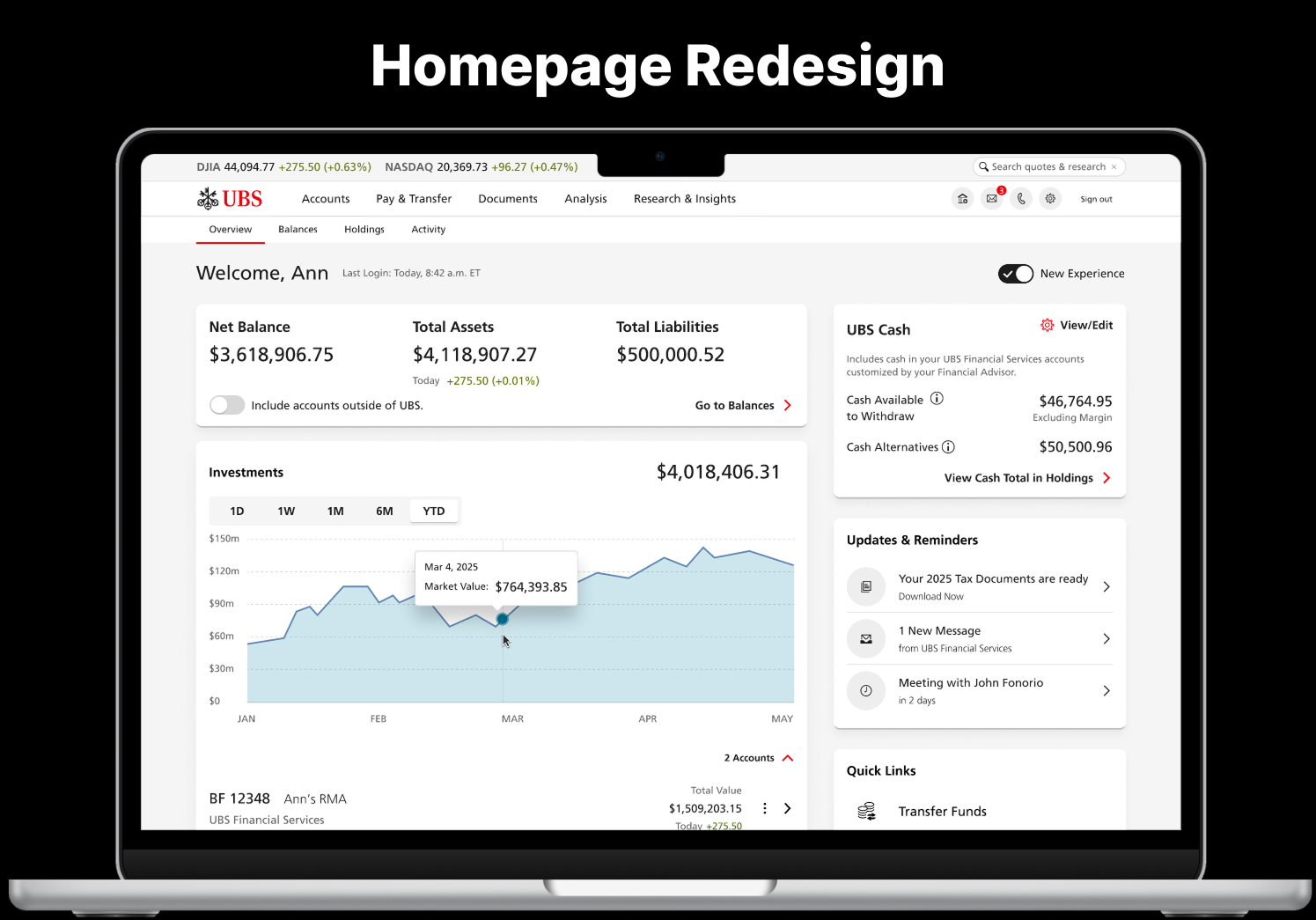
A year-long initiative to identify and validate the highest-impact improvements to the UBS Wealth Management homepage, the primary digital touchpoint for 750,000 U.S. accounts.
Methodology spanned three rounds of user interviews, a 130-client survey, a competitive analysis of major U.S. banks, and a structured usability test, and one finding was consistent across all of it: clients wanted a single chart showing their account value over time, something the platform had never offered.
I built the business case, navigated approval across product owners, legal, and two executive directors (including a COO direct report), and secured sign-off on the significant data infrastructure investment required to build it. The feature is now in development as part of a multi-million dollar homepage redesign.
-
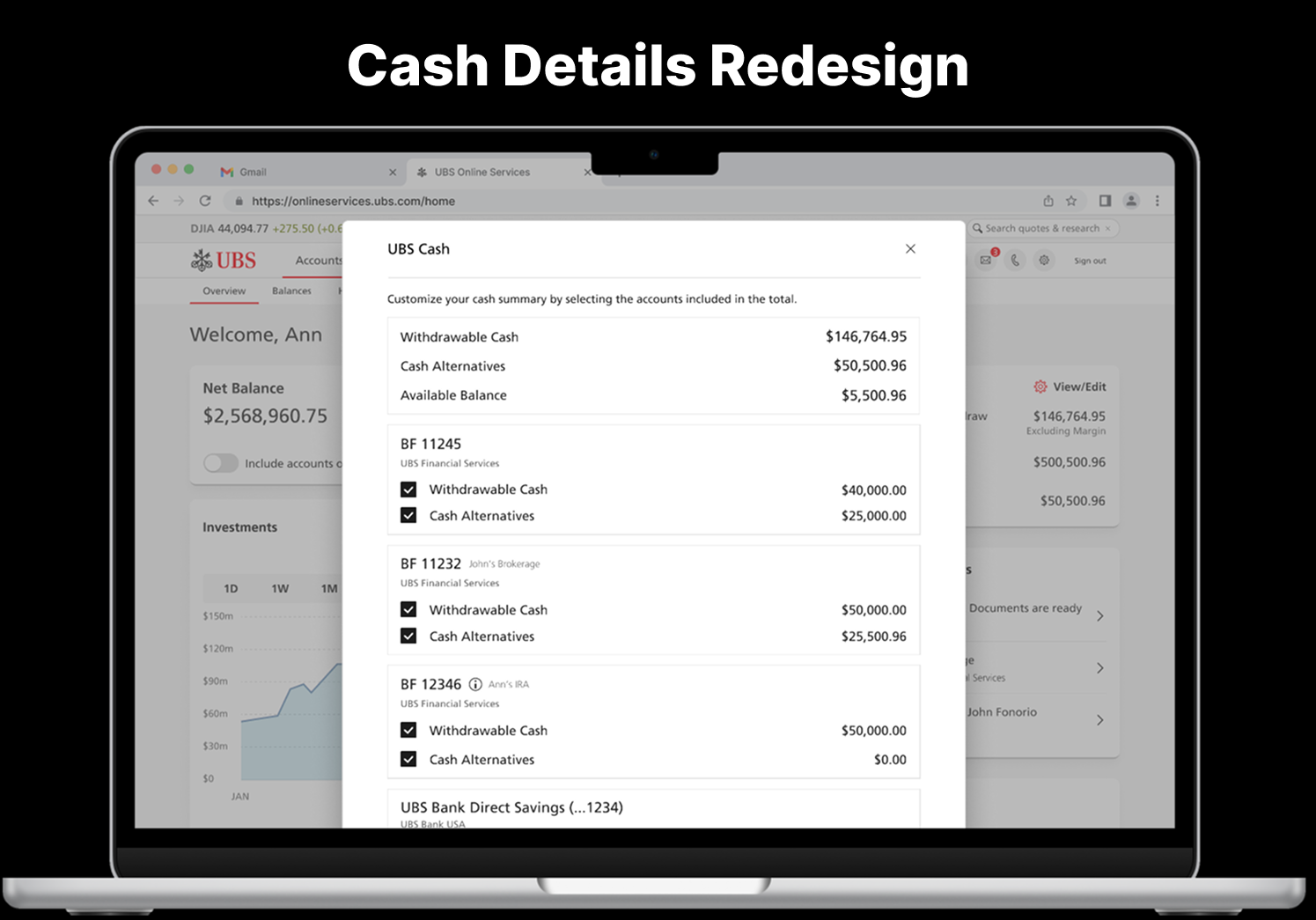
An 18-month engagement that began with a single question: why weren't clients finding the new Cash Tile useful?
Five rounds of research with financial advisors and clients revealed the core issue: the tile displayed an aggregate balance across all accounts, including illiquid investment and retirement holdings that clients would never access for everyday needs.
Working as both lead researcher and design director, I translated those findings into a prioritized set of design opportunities, consulting with visual designers and producing mockups to drive each iteration forward. The result is a fully validated, dev-ready redesign featuring a customizable cash view, an account-level balances overlay, and a copy update to "Cash available to withdraw" — changes that reframe the tile from a passive data display into something clients can actually act on.
-
An active initiative to migrate 15,000+ UBS field advisors, client service representatives, team associates, and support staff onto Microsoft Dynamics, consolidating users from both legacy software and manual spreadsheet workflows.
My role is to lead structured feedback sessions across two user groups: current pilot users already working in the system, and prospective users previewing it ahead of rollout.
Each round of research is synthesized into a prioritized set of product requirements, directly informing what needs to be built within the API before the platform goes live at scale. Ongoing.
-
Before I joined UBS, the organization had never run a structured usability test on any of its client-facing digital products. I built the practice from scratch: evaluated a shortlist of vendors, piloted and implemented UserTesting as our platform of choice, and trained four researchers on structured testing protocols.
The practice is now embedded across the product development cycle, giving product owners a repeatable way to validate design decisions with real clients before anything ships.
PLAYGROUND NEW YORK
-
I built a 27,000-follower TikTok audience around Ivy style, vintage fashion, and the world Playground lives in before the brand ever existed as a commercial entity.
The content reached 22,000 followers before a single product was mentioned, which was intentional: building an audience first meant the brand launched into a community that already trusted the point of view behind it.
The channel now serves as Playground's primary marketing and distribution platform, and the content strategy has always been the same: be genuinely obsessed with the subject, and the audience follows.
-
Every Playground garment starts the same way: finding an archival or vintage piece with the right proportions, taking original measurements from it, and building a technical flat in Figma that translates those references into a manufacturer-ready spec.
The flats include front and back views, precise measurements, fabric and material callouts, construction details, and revision notes; everything a factory needs to produce a first sample.
The George Pleated Trouser, Playground's hero product, was built off measurements taken from a 1950s vintage wool pair. The sweater, tank, and remaining catalog pieces followed the same process.
Designing this way, rooted in archival reference rather than trend, is a deliberate choice. It's how Playground stays connected to the Ivy style tradition that the brand is built around.
-
Playground's hero product, the pleated trouser, was designed from original measurements taken from a 1950s vintage wool pair.
Once the design was finalized as a technical flat, I sourced and contracted an overseas manufacturer to bring it to production, managing every step of that process independently.
Working directly with a factory, rather than through a middleman, gives Playground full control over quality and cost at the quantities a small brand actually operates at.
-
Built and operate a fully independent DTC e-commerce store on Shopify, taking Playground New York from zero to $31K in revenue within 8 months of launch.
Running the entire operation solo: inventory management, order fulfillment, customer communication, and ongoing catalog development across 8 SKUs.
Every system, workflow, and process was set up and is maintained by one person.
-
Before working with manufacturers, the first Playground products were made by hand.
The original hoodies were heat-transfer printed using vinyl, and the cropped t-shirts were individually hemmed on a sewing machine I taught myself to use. I sold all 30 of the first run.
The process was inefficient by design standards, but it gave me a ground-level understanding of garment production that still informs how I work with manufacturers today.


TSHIRT.APP
-
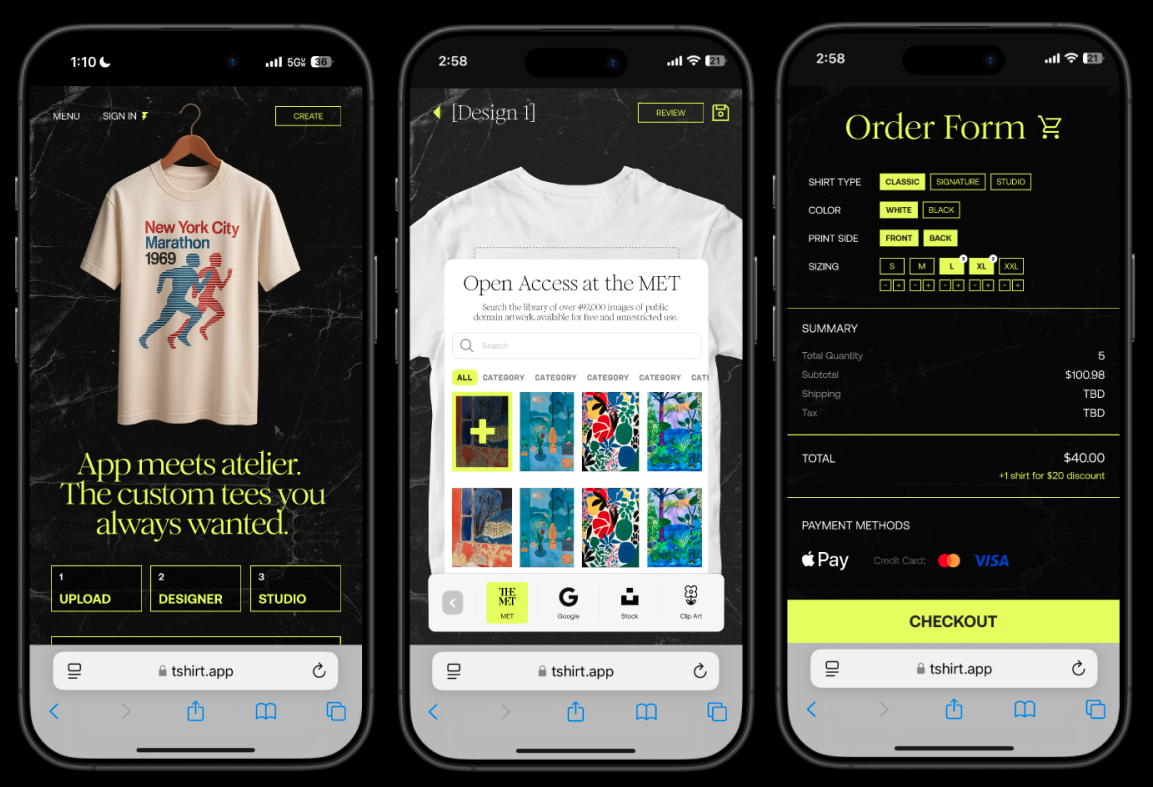
A mobile print-on-demand app designed to fill the gap between mass-market services like Custom Ink and professional design tools that require real expertise.
The target user was someone designing one-off merch for a fraternity event, a wedding, or a group outing who wanted genuine creative control without a steep learning curve.
The key product insight was pairing a simplified mobile design canvas with access to searchable public domain image libraries, including the MET Museum's Open Access collection of over 200,000 artworks, giving users the ability to create distinctive pieces without copyright concerns.
The business model ran on print-on-demand fulfillment with quality blank selection and Shop Pay checkout optimized for fast mobile conversion.
-
Built the full UX system and component library in Figma, then used Replit and natural language programming to translate those designs into a functional mobile build.
The designer canvas was the centerpiece: a simplified tool where users could upload images, add text and shapes, and pull artwork directly from the MET's Open Access API, with each element behaving as an independent object on the canvas.
The Figma-to-Replit workflow meant every design decision made at the spec stage was reflected directly in the working product. The app was fully functional with a live Shop Pay checkout, though it was never formally launched.